Salary Negotiation in Quebec: Complete Guide with Scripts and Strategies
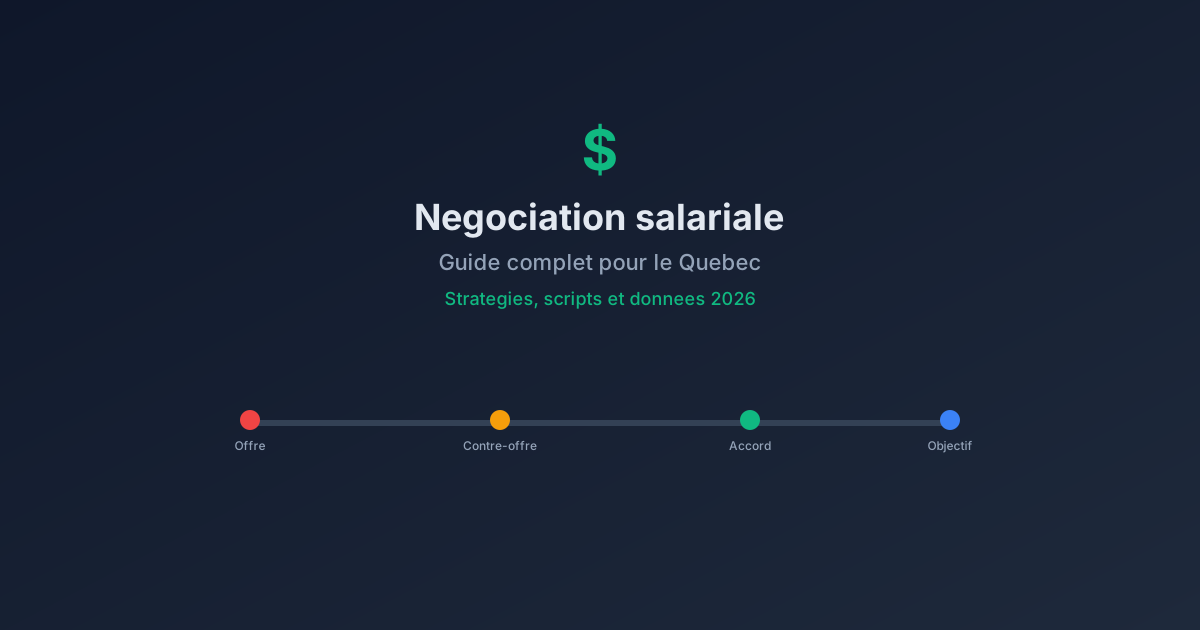
Salary negotiation is one of the most valuable skills in your career, yet the majority of workers in Quebec don't dare negotiate. According to statistics, 58% of Canadians have never negotiated their salary, potentially leaving tens of thousands of dollars on the table over the course of their career. In 2026, with average salary increases projected at 3.2% in Quebec (source: Ordre des CRHA), knowing how to negotiate is more important than ever.
When to Negotiate
There are three key moments to negotiate your compensation:
1. At Hiring
This is when you have the most leverage. The employer has already invested time and resources in your recruitment process. The negotiation range is typically 10 to 20% above the initial offer, depending on the role and sector.
2. During the Annual Review
The review period is the natural time to discuss a raise. Prepare your case 2 to 3 months in advance by documenting your achievements.
3. After a Promotion or Change in Responsibilities
If your responsibilities have increased without a salary adjustment, you have a solid case for negotiation.
Preparation: 80% of Success
Know Your Market Value
Before any negotiation, you must know what you're worth. Use these resources:
- Our tech salary guide: Check salary ranges by position in Quebec
- Job Bank: The federal site provides salary data by profession and region
- Glassdoor and LinkedIn Salary: Self-reported data but useful as a reference
- Your recruitment agency: At VALO, we advise our candidates on realistic market salary expectations
Document Your Achievements
Prepare a concrete file of your contributions:
- Completed projects and their measurable impact
- Revenue generated or costs reduced
- Skills acquired or certifications obtained
- Positive feedback from clients or colleagues
- Additional responsibilities assumed
Define Your Range
Establish three numbers before negotiating:
- Your ideal: The salary you're aiming for in the best scenario
- Your realistic target: The figure you consider fair and achievable
- Your floor: The minimum below which you'll decline
Negotiation Scripts
Script 1: At Hiring
When the employer makes an offer:
"Thank you for this offer, I'm very excited about joining your team. Based on my market research and my overall experience, particularly [mention a key achievement], I was expecting a range closer to [amount]. Would it be possible to discuss this?"
Script 2: During the Annual Review
"Over the past year, I have [achievement 1] and [achievement 2], which contributed to [measurable impact]. Comparing with market data for a similar profile, I would like to discuss an adjustment to [amount]."
Script 3: If the Employer Says No
"I understand the budget constraints. Would it be possible to consider other forms of compensation: performance bonus, additional vacation days, training budget, remote work flexibility, or a review in 6 months?"
Negotiable Elements Beyond Salary
In Quebec, total compensation includes much more than base salary:
- Bonuses and premiums: Performance bonus, signing bonus, retention bonus
- Vacation: Beyond the legal minimum, many employers offer 3 to 5 weeks
- Flexible work: Remote work, flexible hours, 4-day workweek
- Training: Professional development budget, certifications, conferences
- Insurance: Dental, pharmaceutical, vision, disability insurance
- Group RRSP: Employer RRSP contributions are essentially free money
- Shares or options: For startups, equity participation can be significant
Salary Increases in Quebec in 2026
Market data shows the following trends (source: Ordre des CRHA, CPQ):
- Average projected increase: 3.2% in Quebec, versus 3.1% for all of Canada
- Tech sector: Tech increases are often above average, between 4 and 8% for high-demand profiles
- Inflation: With inflation back below 3%, the 2026 increases represent a real purchasing power gain
For the third consecutive year since the projected peak of 4.1% for 2023, organizations are slowing increases. However, employers want to remain attractive, and increases remain above the cost of living increase (source: La Presse, January 2026).
Fatal Negotiation Mistakes
- Giving a number first without research: Let the employer make the first offer when possible, or announce a figure anchored high but justified
- Accepting immediately: Even if the offer is good, take 24 to 48 hours to think. It shows you take the decision seriously.
- Threatening to leave: Negotiation should remain collaborative, not adversarial
- Comparing yourself to colleagues: "My colleague earns more" is never a good argument. Focus on your value and the market.
- Neglecting the total package: A lower salary with 5 weeks of vacation and full remote work can be worth more than a higher salary with 2 weeks and in-office requirements.
The Tech-Specific Case
In Quebec's technology sector, salary negotiation has specific characteristics:
- Ranges are wider (30 to 50% gap between low and high end)
- Rare skills (AI, cybersecurity, cloud) command significant premiums
- The market favours candidates: a tech unemployment rate below 3.5% gives you leverage
- Counteroffers are frequent: 40% of tech candidates receive a counteroffer from their current employer
At VALO, we support our candidates in salary negotiation by providing accurate market data and strategic advice. Browse our tech openings to know current market salaries.
To evaluate your salary positioning, Steppia analyzes your profile and skills to give you a realistic estimate of your market value in Quebec.
Read also: Quebec tech salary guide | How to stand out in a job interview | The 10 most in-demand tech jobs
Besoin d'aide pour recruter ?
Nos experts tech vous accompagnent pour trouver les profils qui correspondent à vos besoins.
Discuter avec un expertOptimisez votre CV avec Steppia
La plateforme reference pour maximiser vos chances sur le marche canadien. Test ATS, preparation entretien et recommandations IA.
Tester mon CV